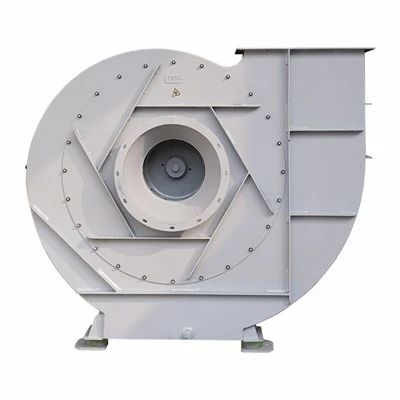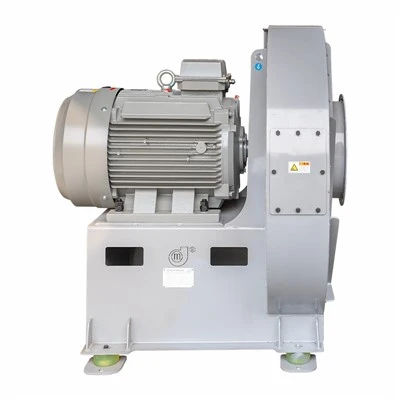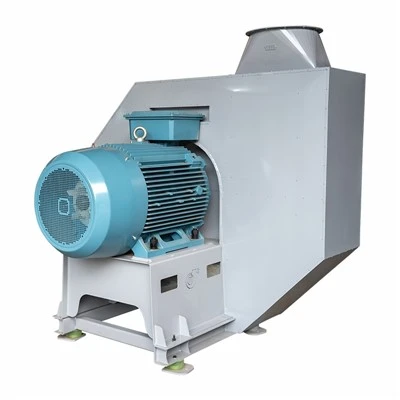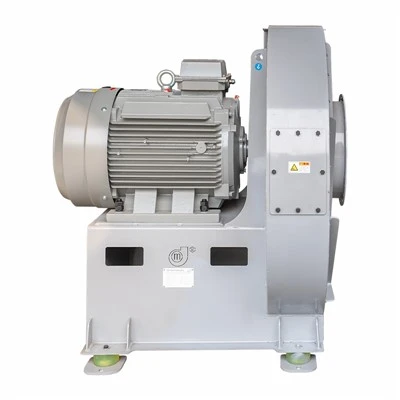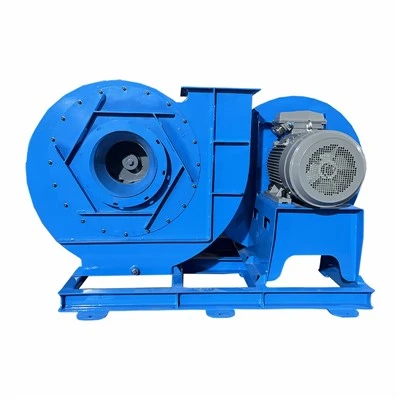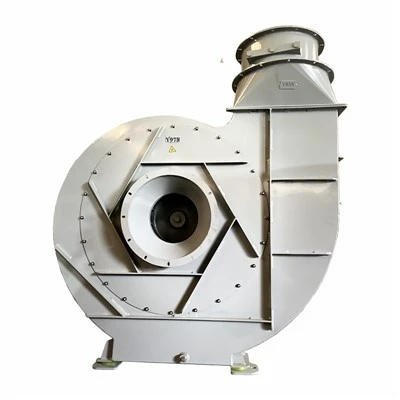

As the impeller of a centrifugal fan rotates, the gas between the blades gains kinetic energy (dynamic pressure head) due to centrifugal force and is discharged from the impeller's periphery. Guided by the volute-shaped casing, the gas flows toward the fan outlet, creating a negative pressure zone at the impeller's center; this draws in a continuous supply of external air, enabling the fan to discharge gas.
The electric motor transmits power to the fan impeller via the shaft, and the rotating impeller transfers energy to the air. The rotation generates centrifugal force, causing the air to spread outward along the impeller blades. A larger impeller imparts more energy to the air, resulting in a higher pressure head (fan pressure). Trimming a large impeller down to a smaller size does not affect airflow volume but reduces the pressure head.
Centrifugal fans primarily consist of an impeller and a casing. Impellers for small fans are mounted directly onto the motor, while those for medium and large fans are connected to the motor via couplings or pulleys. Centrifugal fans typically feature single-side intake and a single-stage impeller; however, high-flow models may utilize double-side intake with two back-to-back impellers, known as double-suction centrifugal fans.
The impeller is the fan's core component; its geometry, dimensions, number of blades, and manufacturing precision significantly influence performance. Static or dynamic balancing of the impeller is essential to ensure smooth fan operation. Impellers are categorized into three types based on blade discharge angle: forward-curved, radial, and backward-curved. In forward-curved impellers, blade tips tilt in the direction of rotation; in radial impellers, blade tips point radially outward (available in straight or curved blade designs); and in backward-curved impellers, blade tips tilt opposite to the direction of rotation.
Forward-curved impellers generate the highest pressure and require the smallest impeller diameter for a given flow rate and rotational speed, though they generally offer lower efficiency. Conversely, backward-curved impellers generate the lowest pressure and require the largest diameter but typically provide higher efficiency. Radial impellers fall somewhere in between. Regarding blade profiles, straight blades are the simplest, while airfoil blades are the most complex. To achieve a suitable velocity distribution across the blade surfaces, curved blades-such as constant-thickness circular-arc blades-are typically employed. Impellers usually feature a shroud to enhance structural strength and minimize gas leakage between the blades and the casing. The blades are joined to the shroud via welding or riveting; welded impellers are lighter and offer smoother flow passages. For small, low- to medium-pressure centrifugal fans, impellers may also be manufactured from cast aluminum alloy.