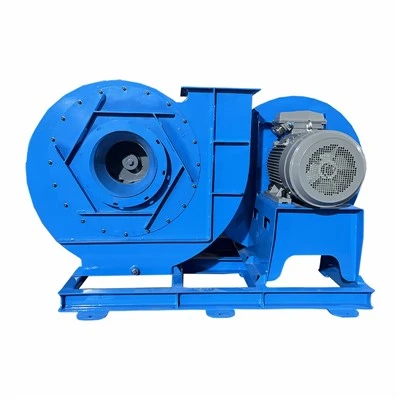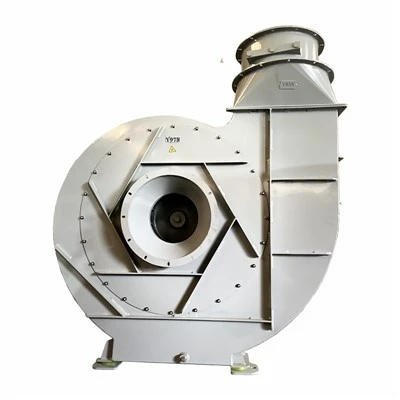

The development of centrifugal fans began with the invention by Guibal in the UK in 1862. By 1880, centrifugal fans featuring volute casings and backward-curved blades-designed for mine ventilation-had been developed, marking a significant refinement in their structural design. Cross-flow fans were developed in France in 1892, while the Sirocco-style centrifugal fan, featuring forward-curved blades, was designed by an Irishman in 1898 and subsequently adopted worldwide. Although axial-flow fans were used for mine ventilation and metallurgical blast applications in the 19th century, their early models suffered from low pressure and efficiency; rapid development did not occur until the 1940s. Key 20th-century advancements included Germany's pioneering use of axial-flow fans for boiler forced and induced draft in 1935, and the development of axial-flow fans with adjustable-pitch blades (adjustable during operation) in Denmark in 1948.
Subsequently, various other types emerged, including contra-rotating axial-flow fans, meridional-acceleration axial-flow fans, mixed-flow fans, and cross-flow fans. By 2002, explosion-proof centrifugal fans in China had seen widespread application and development across sectors such as the chemical, petroleum, and machinery industries. Modern multi-stage centrifugal fans, a crucial category for high-pressure operations, utilize a design that connects multiple sets of impellers and return vanes in series to progressively increase gas pressure; this makes them highly suitable for high-pressure applications while also ensuring a long service life.